
July 29, 2026
How to Spot Fake Trading Cards: A Collector's Authentication Guide
Get a complete guide on how to spot fake trading cards. Learn feel, print, font, and holo tells that reveal counterfeits of Pokemon and sports.

A counterfeit card can look convincing at a glance, especially when you are buying online or handling a set you have never collected before. That matters more as the hobby grows: eBay's trading card category rose 142% in 2020. While Verified Market Research projects the global sports trading card market could reach $98.75 billion by 2027. The more valuable the market becomes, the more incentive counterfeiters have to produce convincing fakes.
Ready to buy with confidence? Browse Packz's authenticated mystery packs , every card is vetted before it reaches your hands.
To learn how to spot fake trading cards, use a five-senses check: feel the stock. Examine the print quality and color, weigh the card, inspect its flexibility, and magnify the surface pattern under a loupe. Compare every finding against a known authentic card from the same set. When a card still raises questions, buy through a trusted source with a documented authentication process, such as Packz, which vets every card before stocking it.
You do not need specialist equipment to catch many counterfeits. Start with the simplest physical clues, because an unusual feel or weight can reveal a problem before you spend time comparing fonts, borders, and holographic details.
How to Spot Fake Trading Cards by Feel and Weight
Your hands can catch problems before a card reaches a sleeve. Weight, flexibility, surface texture, and the way light moves through the stock all reveal clues that a quick visual scan can miss. Use these checks carefully on loose cards, and avoid bending a valuable card hard enough to risk damage.
Try the quick inspection checklist first
- Weigh it. For an authentic Magic: The Gathering card, a useful reference range is approximately 1.7 to 1.8 grams on a digital scale accurate to a tenth of a gram. Compare with a known authentic card from the same game and era.
- Bend it gently. Authentic cards flex with some spring and return toward their original shape. Counterfeits may feel flimsy, overly stiff, or too easy to crease.
- Shine a light through it. Real Magic cards allow light through the stock with a blue tint created by the center glue layer. If light cannot pass through at all, treat the card as suspicious.
- Feel the surface. Run your fingers across the card. A fake may feel waxy, unusually slick, or noticeably different from a trusted card.
Check the card's layered construction
Modern cards are built in layers. Authentic Magic cards have a blue glue center layer between the printed faces. When you apply only gentle pressure in a controlled check, the stock should flex and show some spring, returning toward its original shape rather than remaining permanently bent.
Counterfeits may feel flimsy, overly stiff, or too easy to crease. Some are made by gluing a printed front onto a proxy. When that construction is bent, the glue can fail and the top layer may crack, lift, or separate. That failure is a serious red flag, documented in this Magic card authentication guide. Do not perform a bend test on a valuable, graded, or irreplaceable card. Compare safer examples instead.
Use light, finish, and texture together
Shine a small light through the card from behind in a dim room. Real Magic cards allow light through the stock, with a blue tint created by the center glue layer. If light cannot pass through at all, treat the card as suspicious. This is a screening test, not a substitute for professional authentication.
Finally, run your fingers lightly across the surface and edges. Authentic cards have a consistent finish and texture for their print run. A fake may feel waxy, unusually slick, or noticeably different from a trusted card. Compare gloss and matte areas, too. A counterfeit can use the wrong sheen, making the surface look overly glossy when the original is matte, or flat when the original has more reflective finish. Texture is an established authentication checkpoint because fakes often fail to reproduce the feel of genuine card stock and coatings, as noted by Black Label Grading.
Print Quality and Color: What Authentic Cards Look Like
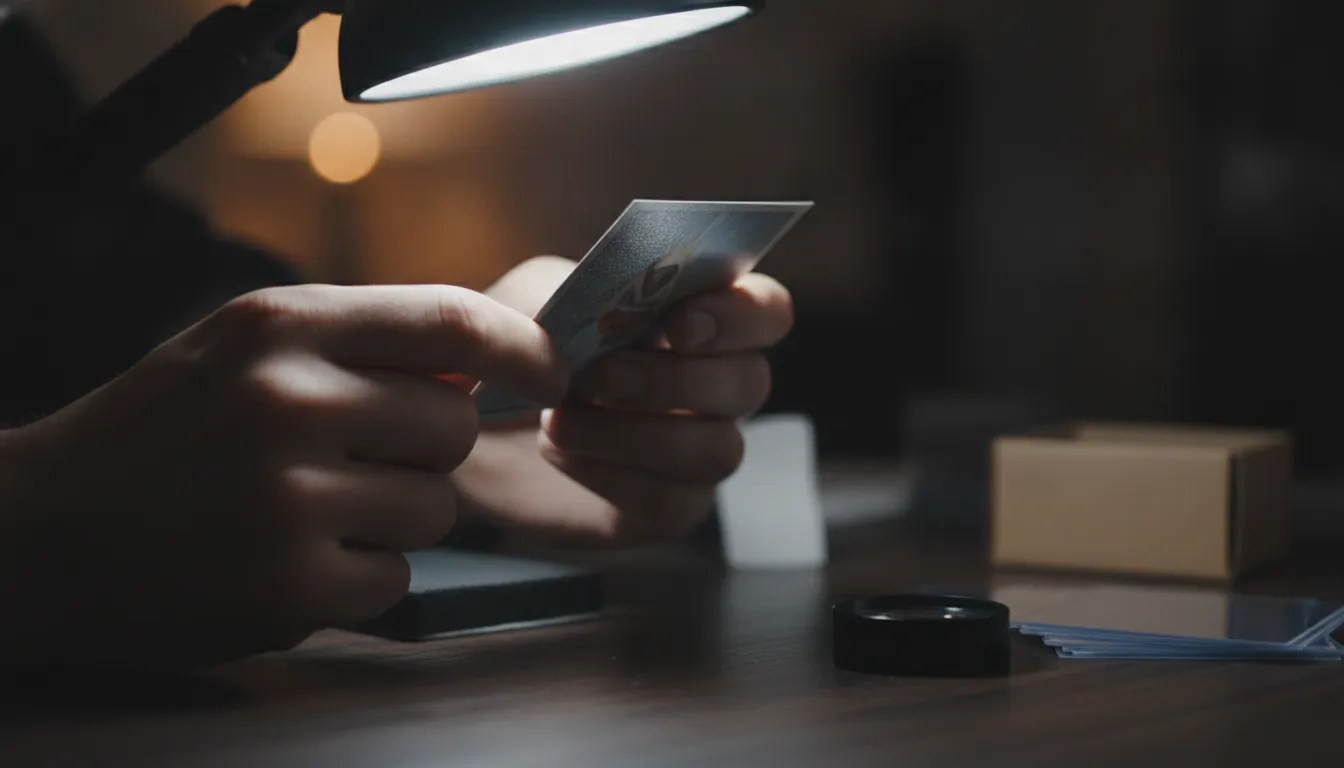
Print quality is one of the quickest ways to separate a genuine card from a convincing copy. Hold the card under bright, neutral light and compare it with a known authentic card from the same set whenever possible. You are looking for the way the image was printed, not just whether the colors look attractive.
Use magnification to inspect the print pattern
Commercial card printing creates a fine rosette pattern, made from tiny colored dots arranged in a repeatable structure. A counterfeit may show broad, muddy areas of solid ink instead, or dots that look irregular and poorly aligned. A jeweler's loupe is inexpensive and gives you enough magnification to inspect the border, artwork, and small color transitions without relying on your eyesight alone.
This is a useful comparison rather than a single pass-or-fail test. Different manufacturers and eras use different printing methods, so compare the suspected card with a verified copy from the same release. Print style and pattern are established authentication checks because counterfeiters often struggle to reproduce the original production process precisely [source].
Watch for unnatural color and holographic patterns
Pay attention to saturation and color balance. A fake can look noticeably too dark or too pale, or show a purple or cyan cast across the artwork. One slightly different screen or scan is not enough to prove a counterfeit. But a color shift combined with muddy detail or an incorrect print pattern deserves closer inspection.
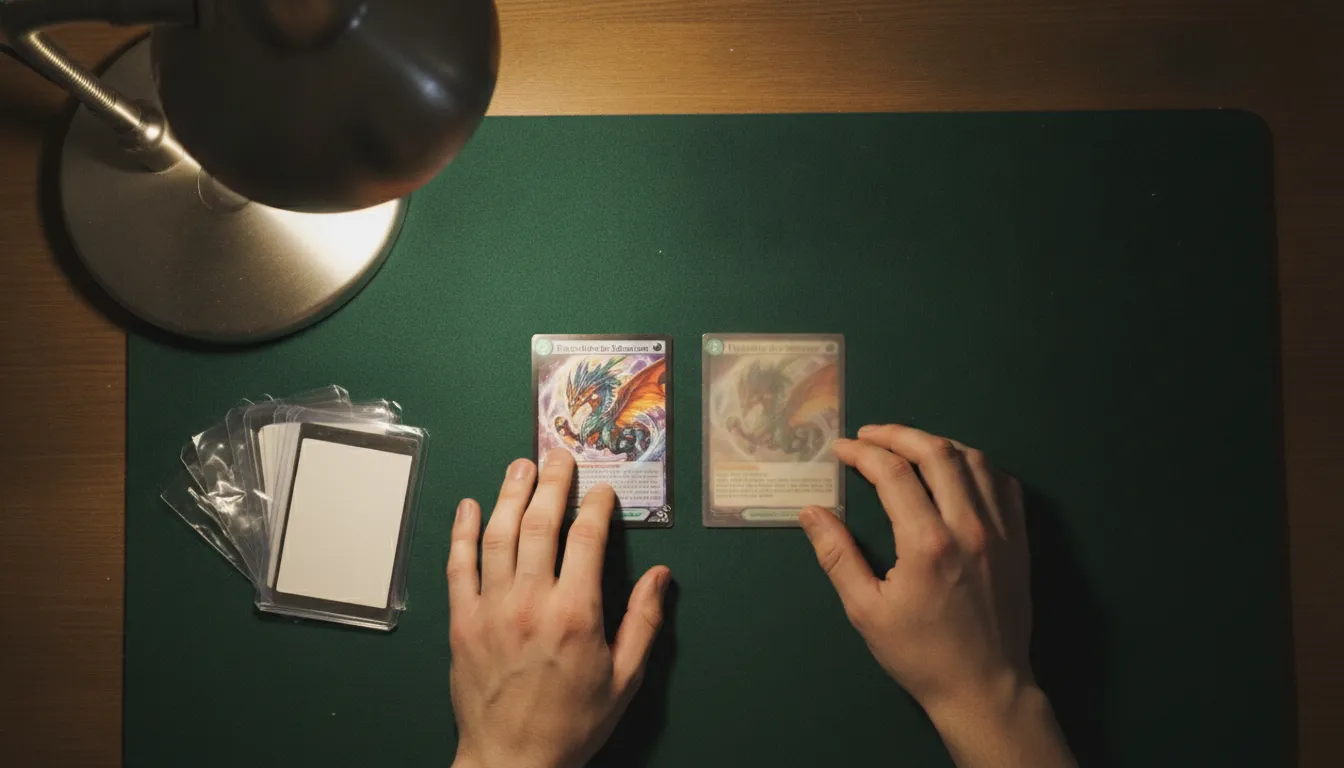
For Pokemon cards with holographic artwork, move the card slowly under a light source. An authentic holo typically shows a consistent star-pattern effect across the image. Fakes may have chaotic shine, a repeated pattern that does not change naturally as the card moves, or no holo effect where one should be present. Compare the suspected card with clear images or a confirmed card from the exact set and variant, since holo treatments vary by release.
Try the back-light test carefully
Card stock provides another supporting clue. Shine a small, bright light behind the card and observe how the light passes through it. Genuine stock may allow some light through with a consistent appearance, while a counterfeit that uses the wrong layers or an overly opaque material can look markedly different. For Magic: The Gathering cards, a blue tint through the card is associated with the authentic blue glue layer. But this test is specific to that product and should not be generalized to every trading card [source].
Do not use a powerful heat source, cut the card, or bend a valuable card to test it. Print pattern, color, holo treatment, and stock should be considered together. When several details disagree with a verified example, pause before buying and seek a professional opinion. Check out Packz's collecting guides for more tips on building your collection safely.
Font, Text, and Border Red Flags
Once a card feels right in your hand, slow down and read it. Counterfeiters can reproduce a general image, but small text details often expose the shortcut. Compare the card with a verified copy from the same set, ideally side by side and under even light. You are looking for several small mismatches, not one isolated imperfection.
Read every line, symbol, and letter
Spelling and grammar errors are among the clearest warning signs. Check the set name, player or character name, rules text, statistics, copyright line, and punctuation. On a Pokemon card, for example, "Pokemon" without the accent or a missing copyright symbol can signal a reproduction. A typo does not prove a card is fake by itself, since genuine cards can have documented printing errors, but unexplained text mistakes deserve a closer inspection.
Font differences are just as useful. Compare the typeface, letter spacing, weight, and size against a known authentic card. A reproduction may use a font that is slightly too bold, too thin, wide, or compressed. Look especially at small numerals, attack costs, set information, and fine print. These details are easy to overlook at normal viewing distance, so use a magnifier when needed. Print quality, color accuracy, borders, fonts, and spelling are all recommended inspection points in trading-card authentication guidance. Black Label Grading outlines these checks.
Check the border and the back
Examine the border on all four sides. An off-center frame, uneven margin, or image that sits noticeably too high or low may indicate cutting or alignment problems during counterfeit production. Slight white protrusions, rough edges, or other defects in the card structure are also red flags because many counterfeits are imperfect reproductions. A card-authentication guide from Matthew IWS describes these structural defects as useful warning signs.
Finally, flip the card over and compare its color and layout with a known authentic card from the same brand and era. Pokemon backs should match the familiar blue tone, while sports cards should preserve the expected team logo placement and back design. Treat this as a comparison test, not a standalone verdict, since lighting, camera settings, and different print runs can change how color appears. If the front typography, border alignment, and back design all look wrong together, stop and verify the card before buying. Browse Packz's authenticated inventory to see cards that have already passed these checks.
Common Counterfeit Techniques: Artificial Aging and Reprints
Counterfeiters do not always aim for a fresh, glossy look. When a card is supposed to be decades old, they may try to manufacture the appearance of honest wear. That can make a questionable card feel convincing at first glance, especially when a buyer is focused on the player, set, or price.
How artificial aging changes a card
One crude method is soaking a card in tea or coffee to stain the edges and darken the surface. Others sand or abrade the edges to imitate handling, then add grime to the corners. A fake may also be printed on paper stock that has been treated to look old. These methods can create uneven discoloration, soft or fuzzy edges, and wear that does not match the card's printing or construction.
Look for consistency rather than simply asking whether a card looks old. Natural aging generally follows the way a card was handled, while artificial aging may leave stains in recessed areas. An overly uniform brown cast, or scratches that cut through printed details. Compare the suspect card with a well-documented example from the same set, including its stock, borders, and print pattern. For especially valuable vintage cards, microscopic inspection may be necessary to identify the printing method and detect alterations, as described in research on authenticating pre-1930 baseball cards (academic authentication research).
Reprints are not automatically counterfeits
A reprint is an authorized reproduction or tribute that is identified as such. For example, the 1952 Topps Archives set released in 1983 was made to commemorate Topps' first set. It becomes a counterfeit when someone presents that reprint, or an unauthorized copy, as an original 1952 card. Check the set's release history, copyright details, card dimensions, and known design differences before treating an older-looking card as vintage.
Use UV light as one supporting check
- Shine a UV flashlight over the card in a dim room. Many authentic cards have UV-reactive elements, though the result depends on the manufacturer, era, and set.
- Compare with a verified card from the same release. A UV response alone does not prove authenticity.
- Combine with other checks. Use UV alongside print, stock, and construction tests before making a call.
These checks matter as the market expands. The global sports trading card market is projected to reach $98.75 billion by 2027. While eBay's trading card category grew 142% in 2020, increasing both legitimate opportunity and the incentive to produce convincing fakes (market and counterfeit-risk analysis). Learn how Packz's 100% instant buyback gives you a safety net on every purchase.
How Professional Grading Protects Collectors
When a card is already authenticated and sealed by a reputable grading company, you are not starting from zero. PSA, Beckett, SGC, and CGC examine the card before assigning a grade and enclosing it in a tamper-evident holder. That process gives collectors a professional opinion on authenticity and condition, rather than asking every buyer to become an expert in printing, stock, and manufacturing history.
What professional graders inspect
Grading is more than a quick visual glance. Services evaluate centering, meaning how evenly the image sits within the borders, along with the condition of the corners, edges, and surface. They also look closely at print quality, color, texture, alignment, and signs of trimming, alteration, or reproduction. These are the same categories collectors use when learning how to spot fake trading cards, but professional graders have specialized tools and experience for inspecting details that may be difficult to see at home. This inspection overview covers print quality, color accuracy, borders, fonts, and spelling.
| Service | Top Grade | Best For | Key Feature |
|---|---|---|---|
| PSA | PSA 10 Gem Mint | Pokemon, modern sports | Most widely recognized resale value |
| Beckett (BGS) | BGS 10 Pristine | Sports cards, high-value modern | Sub-grades for centering, corners, edges, surface |
| SGC | SGC 10 Pristine | Vintage sports cards | Fast turnaround, strong vintage reputation |
| CGC | CGC 10 Pristine | Pokemon, modern TCG | Detailed sub-grades and census data |
Grades communicate the result in a standard format. A PSA 10 is described as Gem Mint, while a BGS 10 Pristine represents an especially strict top-tier assessment under Beckett's scale. The label does not make a card valuable by itself, but it makes the card's condition and authentication easier to evaluate, compare, and resell.
Why graded cards are a safer starting point
Buying a graded card does not mean you should ignore the seller or the holder. Check that the slab, label, and certification details are consistent with the grading company, and avoid listings that rely on pressure or vague provenance. Still, a professionally graded card removes the biggest burden of buying raw: the grader has already verified the card before it reaches you.
Frequently Asked Questions
How can you tell if a trading card is fake?
Start with the card's edges, surface, weight, print quality, and back. Look for white protrusions, unusual texture, blurred detail, inaccurate colors, misspelled words, or borders that do not match a known authentic example. A card that feels unusually flimsy or stiff deserves a closer inspection. No single clue proves a counterfeit, so compare several details before deciding.
Are fake Pokemon cards easy to spot?
Some are, but convincing counterfeits can require magnification and comparison with a verified card from the same set. Check the font, energy symbols, color saturation, border spacing, card back, and holographic pattern. A jeweler's loupe can reveal differences in the printed dot pattern. Avoid bending a valuable card just to test it, since inspection should not create damage.
How do you check if sports cards are real?
Compare the suspected card with a reliable scan or authenticated copy, focusing on print pattern, card stock, borders, fonts, spelling, and centering. Sports-card counterfeits may struggle to reproduce the original printing process and cardboard composition, so differences in texture or density can be useful warning signs. Vintage cards and high-value examples often warrant professional authentication rather than a home-only check.
Can a light or bend test confirm a card is authentic?
These tests can provide clues, but neither is a universal guarantee. Some Magic: The Gathering cards have a blue glue layer that can give transmitted LED light a blue tint, according to an authentication guide from Matthew IWS (source). Bending can damage a card, and glued counterfeit layers may crack or separate, so use non-destructive checks first and seek a professional opinion for valuable cards.
Ready to Browse Packz's Authenticated Mystery Packs?
Recommended Reading
Cash for Graded Sports Cards: The Fastest Ways to Sell
Get cash for graded sports cards faster. Compare auction houses, marketplaces, and instant buyback options to pick the route that fits your timeline.
How to Compare Value in Sports Card Packs
Learn how to compare sports card packs using card quality, available pulls, pricing clarity, and Packz’s 100% buyback option.
How to Buy Pokemon Packs Online for Ripping
Ready to buy pokemon packs online for ripping? Get transparent pack value and clear pull odds so you never overpay for the thrill of the hunt. Start collecting safely.